In this article
Priority One: The repairs that kept water flowing
When a high-lift pump fails at a major Water Supply Works, the consequences aren’t abstract—they are immediate, far-reaching, and felt in every household and industrial site the station serves.

In the South of England, one such risk grew quietly for years, hidden behind ageing motors, moisture-laden galleries, and stretched maintenance teams. What it needed wasn’t luck – it needed intervention. And not just any intervention, but Priority One repairs carried out at pace and with absolute technical certainty.
This is the story of how ERIKS helped keep drinking water flowing to safeguard supply to a major refinery, and restored stability to a system operating closer to the edge than anyone realised.
When Time Catches Up With Critical Assets
Back in 2022, ERIKS carried out an in-depth survey of the site’s high-lift pumps – vast pieces of equipment responsible for pushing water across the region’s supply network.
The findings were unambiguous. Several slipring motors were decades old, maintenance had largely been reactive, and the environmental conditions in the open-sided pump gallery meant moisture ingress was not just possible but inevitable. The report made one recommendation clear: treat these pumps as high priority.
But in an industry where maintenance teams are stretched thin and capital budgets are always under pressure, it is all too easy to focus on what seems manageable rather than what is essential. Lower-risk pumps were repaired first. And then the inevitable happened - the very pump flagged as critical failed.
Suddenly the consequences were no longer hypothetical. Five pumps feeding the region’s drinking water, and five more supplying a refinery with volatile, fluctuating demand, were now operating without the safety margin that keeps a network resilient.
If multiple pumps failed at once, it wouldn’t just be inconvenient – it could stop a refinery, disrupt household supply and seriously damage public trust.
Maintenance Strategy Stretched to Breaking Point
Years of reactive maintenance had taken their toll. Many of the pumps had run continuously for decades. The isolation valves – vital for safely removing pumps – hadn’t been operated in so long that several had seized completely. One pump had even been out of action for more than twenty years due to an over-trimmed impeller that left it dramatically under-performing.
Any hope of phased refurbishment vanished. Every repair now carried P1 status, meaning work had to begin immediately. No waiting for quotes. No convenient scheduling windows. Remove, repair, reinstall – fast.
This is precisely the environment where ERIKS’ engineering teams excel.
Years of reactive maintenance had taken their toll. Many of the pumps had run continuously for decades. The isolation valves – vital for safely removing pumps – hadn’t been operated in so long that several had seized completely. One pump had even been out of action for more than twenty years due to an over-trimmed impeller that left it dramatically under-performing.
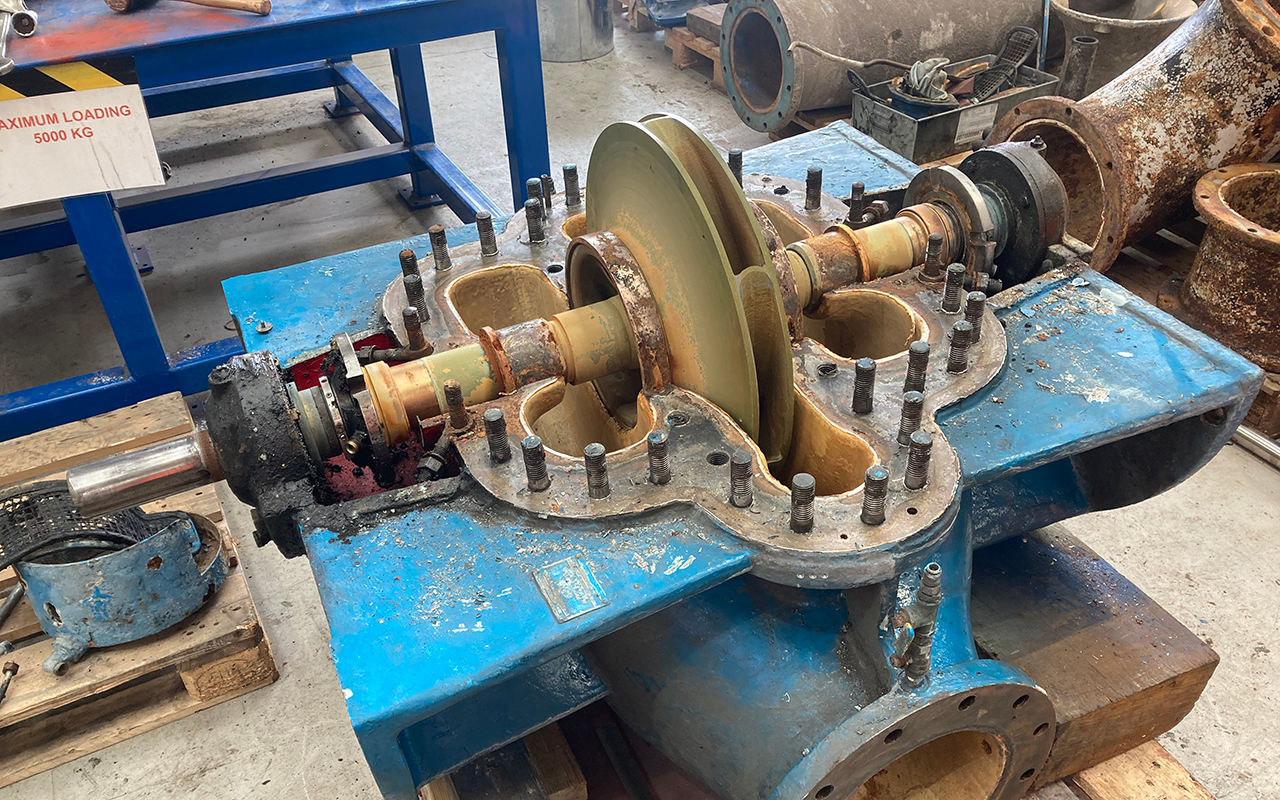
Any hope of phased refurbishment vanished. Every repair now carried P1 status, meaning work had to begin immediately. No waiting for quotes. No convenient scheduling windows. Remove, repair, reinstall – fast.
This is precisely the environment where ERIKS’ engineering teams excel.
Rebuilding Reliance, Not Just Equipment
From the moment each asset arrived at the ERIKS Workshop, the process followed a singular objective: return the pump and motor to as close to original specification as possible – reliably, safely, and quickly.
Slip-ring motors were fully stripped, electrically tested, and mechanically restored. Rings were skimmed and brush gear renewed to ensure clean, stable current transfer.
Insulation resistance readings – low on several moisture-affected motors – were corrected through controlled drying and overhaul.
The pumps themselves underwent a similarly rigorous programme. After complete disassembly, casings were shot-blasted, restored, and coated with Belzona to combat erosion. Impellers were inspected for wear and balanced to tight tolerances, an essential step for reducing vibration and extending bearing life.
New mechanical seals, sleeves, and wear rings were fitted throughout. Once rebuilt, every unit was tested under load on ERIKS’ dedicated pump test rig to verify flow, pressure and mechanical integrity before returning to site.
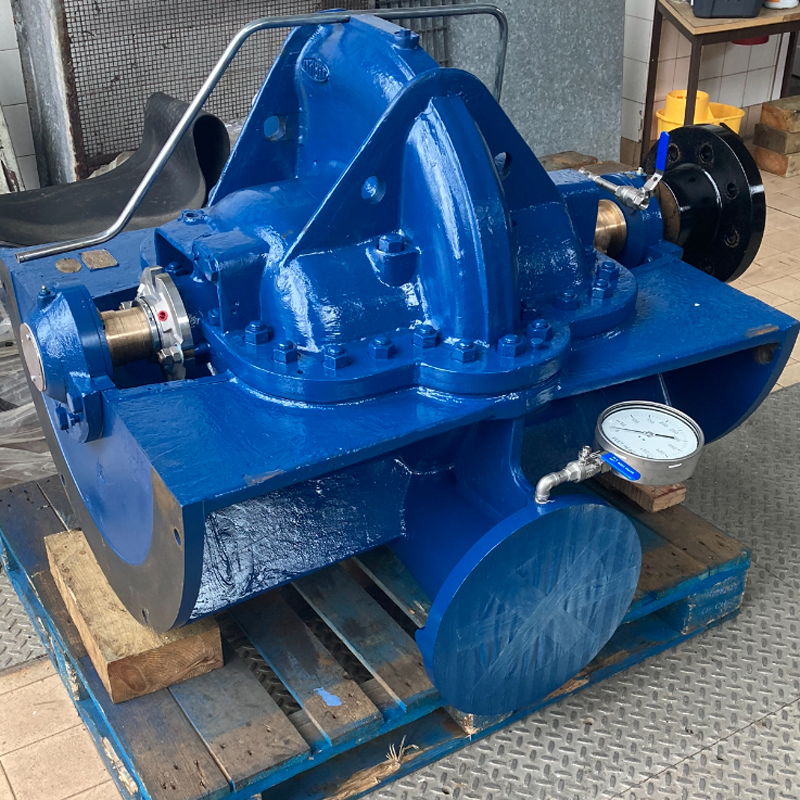
Despite the complexity, turnaround times were consistently met. No unplanned outages. No sudden supply gaps. Just a steadily strengthening system.
Restoring Confidence, Not Just Capacity
With all five drinking water supply pumps and two of the refinery units now fully overhauled – and more work planned – the site has shifted from crisis-driven firefighting to a position of renewed reliability.
The transformation wasn’t simply about fixing what was broken. It was about rebuilding the margin of safety that entire communities and critical industries depend on.
For more information on Water and Wastewater, or get in touch with your local ERIKS Service Centre who will be happy to discuss your options.
#ERIKSUKI #Wastewater #ClarifierDrives #RotatingEquipment #EngineeringSolutions
Author

Share the article
Thirsty for more?
Explore more water solutions and services from ERIKS.